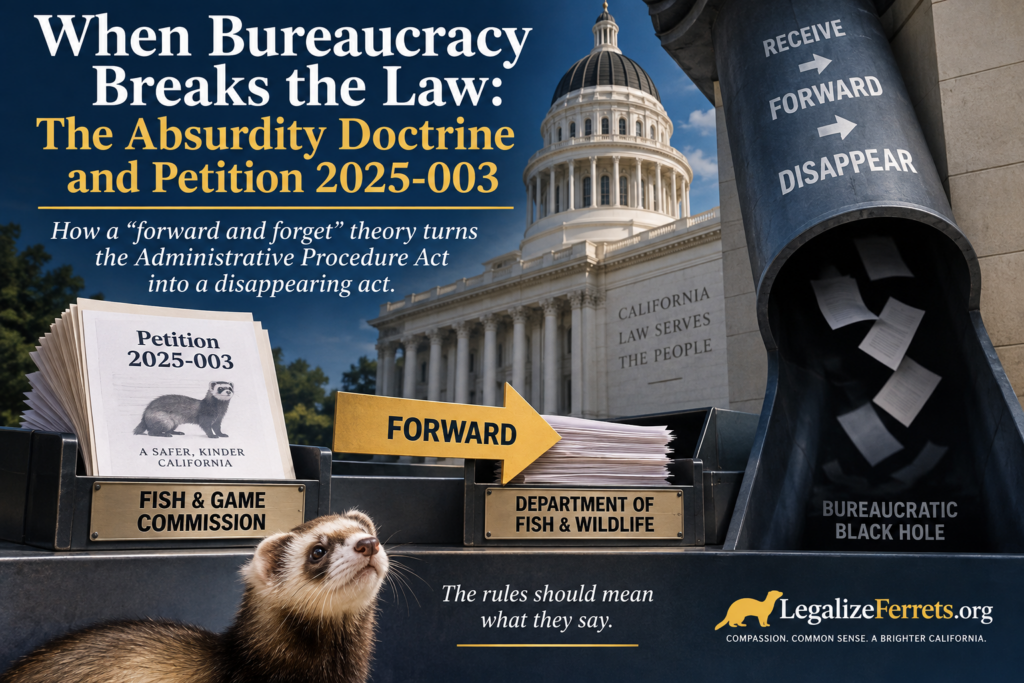
When Bureaucracy Breaks the Law:
The Absurdity Doctrine and Petition 2025-003
How a “forward and forget” theory turns the Administrative Procedure Act into a disappearing act.
Every once in a while, you run into a government argument so strange, so hollow, and so self-defeating that you have to stop and ask: How is a government agency allowed to get away with this?
That’s exactly where we are with Petition 2025-003.
In May 2026, the State of California filed demurrers claiming that the Fish and Game Commission satisfied all of its legal obligations simply by accepting the petition and forwarding it to the Department. According to them, that one internal handoff—a bureaucratic game of “not it!”—counts as fulfilling the entire Administrative Procedure Act (APA) process.
If that sounds bizarre, you’re not alone. There is a specific legal name for this kind of problem: the absurdity doctrine.
What Is the Absurdity Doctrine?
The absurdity doctrine is a real, long-standing rule of statutory interpretation. Courts use it when a party’s literal reading of a statute would produce results the Legislature could never have intended.
This doctrine exists because statutes are supposed to function. They are meant to create processes, obligations, and outcomes. When an agency interprets a statute in a way that makes the entire process meaningless, judges step in and say, “No, that’s not how this works.”
Why the State’s Argument Triggers It
Let’s look at what the State is actually claiming: The Commission “accepted” Petition 2025-003 the moment it forwarded it to the Department of Fish and Wildlife, and that referral alone satisfies the law.
If a judge accepts that argument, it sets a troubling precedent. It means any future citizen petition could be:
- “Accepted” and immediately forwarded without ever requiring a public hearing.
- Stripped of a vote, a final decision, or written reasons.
- Trapped in limbo forever, never returning to the Commission and never being resolved.
We don't have to guess how this ends—we already lived it. In 2011, a previous ferret petition vanished into this exact bureaucratic black hole. No hearing. No vote. No decision. Just gone. The absurdity doctrine exists precisely to prevent history from repeating itself.
The Two Versions of the Law
To see just how broken the State's logic is, compare what the law was designed to do versus how the State wants to interpret it:
|
What the Law Intended The APA |
What the State Is Claiming |
| A clear, structured path to an agency decision with written reasons. | An internal handoff that functions as an evacuation chute. |
| Citizens get a voice, an answer, and a right to judicial review. | The petition disappears into a bureaucratic black hole. |
The Heart of the Absurdity
A statute requiring agencies to notify petitioners of their “decision and the reasons for the decision” cannot be interpreted to allow the agency to make no decision at all.
The Legislature did not create a petition process so agencies could avoid making hard choices. They created it so agencies must make choices. By claiming no final decision has been made, the State is simply trying to lock the courthouse doors so a judge can never review their actions.
Why This Matters Beyond Ferrets
This isn’t just about ferrets. It’s about whether California agencies can make your rights disappear. If the State’s interpretation stands, any citizen petition on any topic can be forwarded and forgotten. No one gets a decision, no one gets reasons, and no one gets accountability.
“No. You don’t get to break the statute by pretending it doesn’t require what it plainly requires.”
Petition 2025-003 is about ferrets, yes.
But it’s also about whether the rules still mean what they say.